
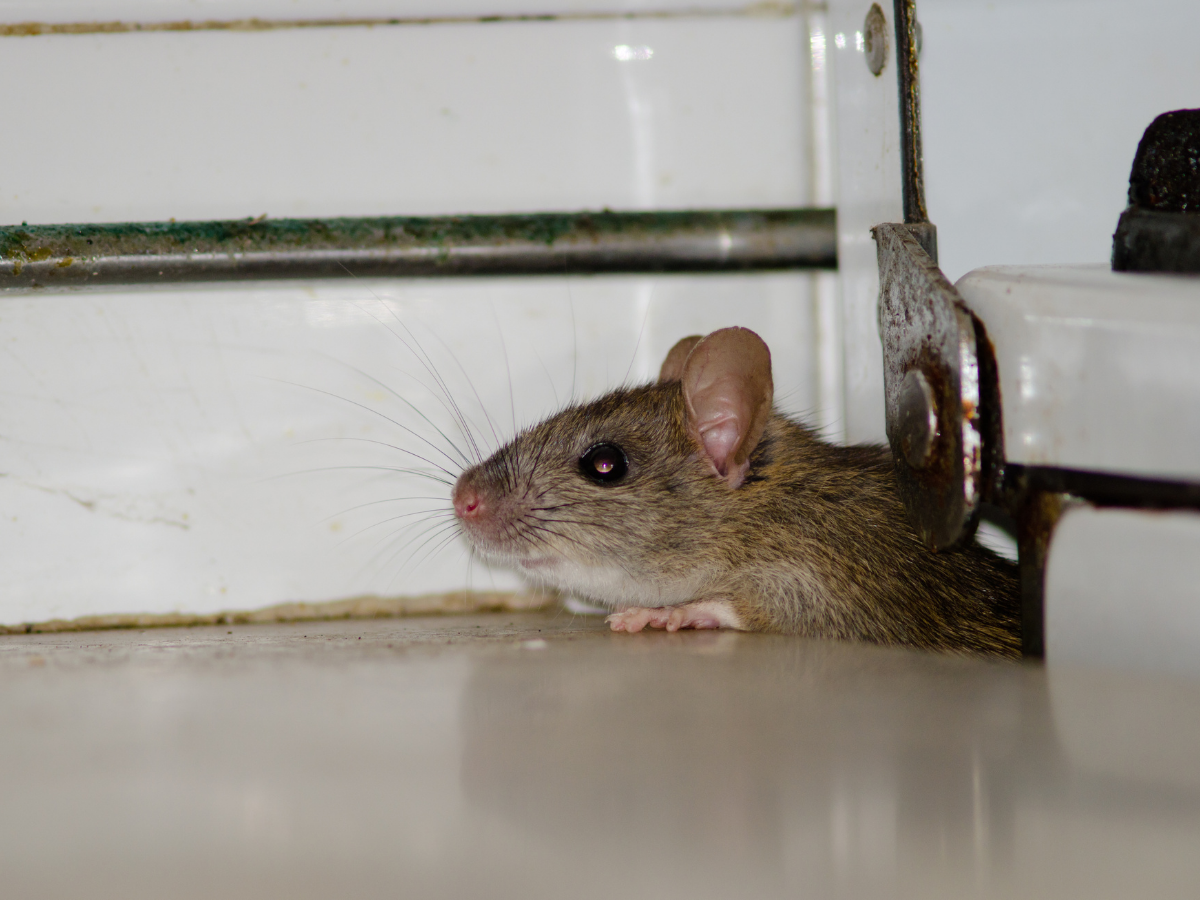
Rodent Control in Southern California: What San Diego, Orange County, and Riverside Homeowners Need to Know in 2026

rodent control in San Diego

Table of Contents

Pest Education · Southern California

Rodent Control in Southern California: What San Diego, Orange County, and Riverside Homeowners Need to Know in 2026

By the AG Pest Team · Updated Spring 2026 · 9 min read · San Diego · Orange County · Riverside

Rodent activity is rising across Southern California, and 2026 is shaping up to be one of the most active spring seasons in recent memory. Mild winters, accelerating urban development, and a wet early season have created ideal conditions for roof rats, Norway rats, and mice to move into homes, garages, and attics across all three counties. Here is what is driving it, where the risk is highest, and what actually works.

Why Southern California has a year-round rodent problem

In most parts of the country, rodent populations cycle with the seasons. Cold winters reduce food availability and push mortality rates up, giving homeowners a natural break. Southern California does not work that way. Temperatures in San Diego, Orange County, and Riverside rarely drop low enough to significantly reduce rodent activity, which means colonies that establish in fall and winter are still active, breeding, and expanding by the time spring arrives.

Urban development accelerates the problem significantly. As new construction breaks ground across the region, natural habitat is displaced and the rodent populations that lived in open land are pushed directly into adjacent residential neighborhoods. This pattern has intensified throughout the Inland Empire and North County San Diego, where development has been most aggressive since 2023. Rodents do not disappear when their habitat is removed. They relocate into the nearest available shelter, which is typically your neighborhood.

2026 update: wetter winter, higher spring pressure A wetter than average early 2026 across Southern California created unusually productive outdoor breeding conditions through winter. Populations that would normally be suppressed by dry conditions entered spring 2026 at elevated numbers. Pest professionals across all three counties are reporting significantly higher call volumes for rodent activity compared to this time last year.

Spring nesting season: why attics fill up fast

Spring is the single most active period for attic invasions in Southern California, and most homeowners do not understand why. The biology is straightforward: as outdoor temperatures warm and female rats and mice enter their peak reproductive cycle, they actively seek enclosed, insulated, dark spaces to build nests and deliver litters. Your attic is the ideal location.

Roof rats, which are the dominant species in coastal and suburban SoCal, are exceptional climbers. They routinely travel along power lines, fence tops, and tree branches to reach rooflines, and a gap as small as half an inch is enough for entry. Once inside, a single breeding pair can produce between 40 and 60 offspring in a year under ideal conditions. By the time a homeowner hears scratching at night or notices an odor, the nest has often been established for weeks.

  • 1
    Scratching sounds at night, especially in ceiling or walls. Roof rats are nocturnal. Sounds that intensify after dark and stop near dawn are a strong signal. The sound typically moves, following the rodent’s travel path through the attic or wall void.
  • 2
    Droppings near the attic access panel, garage beams, or entry points. Rat droppings are 12 to 20mm long and tapered at both ends. Mouse droppings are smaller (3 to 6mm), resembling dark rice grains. Finding fresh droppings confirms active infestation, not just a past one.
  • 3
    Gnaw marks on wood, wiring, or stored items. Rodents gnaw constantly to manage incisor growth. Chewed electrical wiring in attics is a serious fire hazard and one of the most common causes of attic-origin house fires in California.
  • 4
    Nesting material in unusual places. Shredded insulation, torn paper, fabric scraps, and plant material piled in a corner of the attic, garage, or crawl space indicate active nesting. Spring nests are often built rapidly and close to heat sources.
  • 5
    Rub marks along walls or beams. Rodents use the same travel routes repeatedly. The oils from their fur leave dark, greasy smear marks along beams, pipes, and wall edges over time. These are most visible in attics and crawl spaces with light insulation.
  • 6
    Unexplained odors, particularly a musky or ammonia-like smell. A persistent odor in the garage, attic, or a specific room with no obvious source can indicate a rodent nest or, in some cases, a rodent that has died in a wall void. Dead rodents inside walls also attract secondary pests.
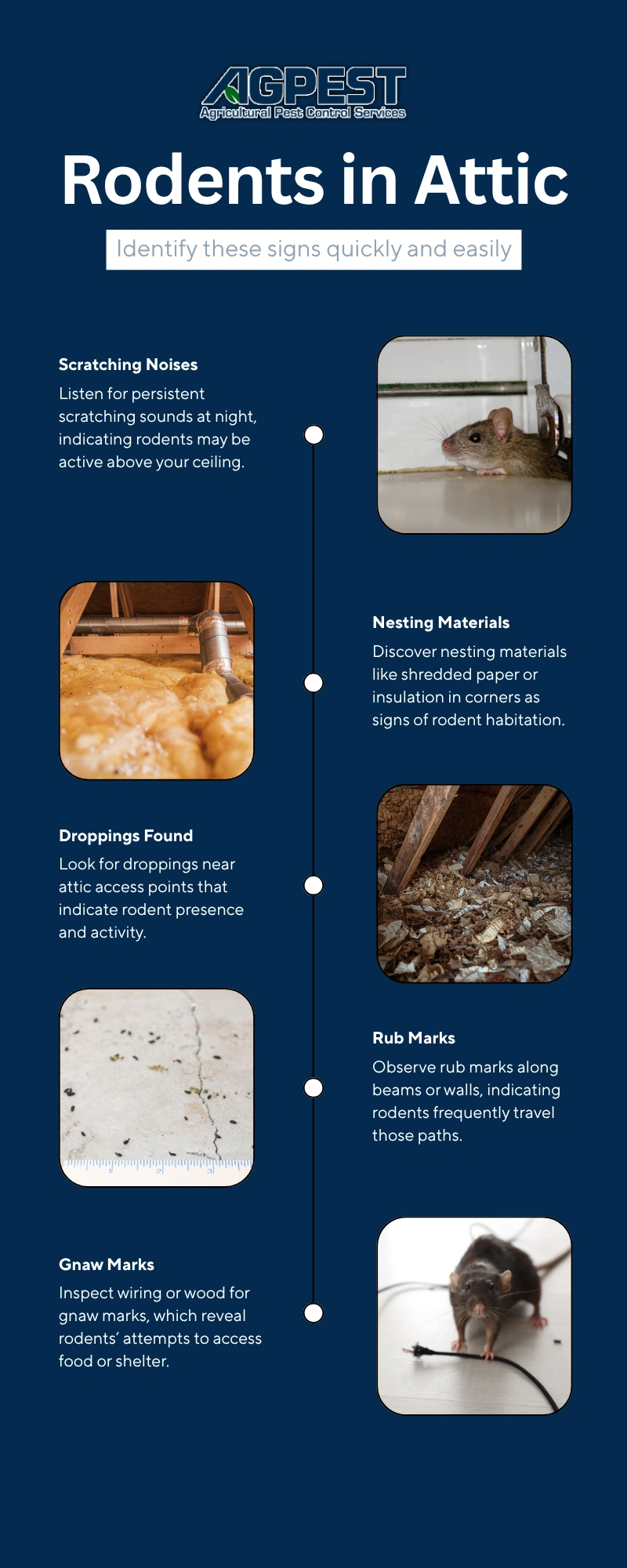
6 signs of rodent activity in your attic: what Southern California homeowners should look for
Roof rats are typically established for 4 to 6 weeks before homeowners notice. These are the signs to catch them early.
AG Pest note: One of the most consistent findings during spring inspections across all three counties is that homeowners underestimate how long rodents have been present. The average gap between first entry and the homeowner noticing something is wrong is 4 to 6 weeks. By that point, a nest is established and exclusion requires a more comprehensive approach than a simple trap placement.

Rodent pressure by county: San Diego, Orange County, and Riverside

Rodent behavior and pressure varies significantly across Southern California depending on climate, development density, and landscape type. Here is what we see most across the counties AG Pest serves.

San Diego County
Roof rats are dominant, especially in coastal neighborhoods (La Jolla, Encinitas, Mission Hills, Chula Vista) with mature tree canopy providing travel corridors to rooflines. North County inland areas (Escondido, Poway, Ramona) see higher Norway rat and ground squirrel pressure driven by ongoing development. Wet canyon areas throughout the county are consistent breeding habitat.
High year-round pressure
Orange County
A mix of roof rats in older residential areas (Fullerton, Orange, Tustin, Anaheim) and Norway rats near commercial corridors and water infrastructure. HOA communities and townhome complexes face elevated risk because exclusion on shared walls requires coordinated building-wide treatment. Spring 2026 has seen above-average activity, particularly in attic-entry calls across North OC.
Elevated spring 2026 activity
Riverside County
Rapid development across the Inland Empire (Murrieta, Temecula, Menifee, Hemet) has displaced significant rodent populations into new residential areas. Desert-adjacent communities see different species pressure including pack rats (woodrats) alongside roof and Norway rats. Heat drives indoor movement in summer, making spring exclusion treatment especially critical before temperatures peak.
Development-driven displacement
Rodent pressure comparison across San Diego County, Orange County, and Riverside County in Southern California
Rodent species, risk windows, and pressure drivers differ significantly across SoCal’s three main counties. Local knowledge matters.

The rodent species Southern California homeowners encounter most

Roof Rat (Rattus rattus)
The most common home-invading rodent in coastal and suburban SoCal. Sleek, dark brown to black, with large ears and a tail longer than its body. An agile climber that enters through rooflines, eaves, and gaps around utility penetrations. Primary attic and wall void pest.
Primary attic pest
Norway Rat (Rattus norvegicus)
Larger and heavier than roof rats. Brown with a blunt nose and shorter tail. Prefers ground-level entry: crawl spaces, garage slabs, and foundation gaps. More common near commercial areas, restaurants, and water sources. Burrows under concrete and along building perimeters.
Ground and crawl space pest
House Mouse (Mus musculus)
Small (6 to 9cm body), light brown to grey. Enters through gaps as small as 6mm. Reproduces rapidly: a single female can produce 60 offspring per year. Common in garages, kitchen cabinets, and wall voids. Often present alongside other rodent species.
High reproduction rate
Pack Rat / Woodrat
Found primarily in Riverside County’s desert-adjacent communities and dry inland areas. Large, with a bushy tail. Known for building large debris nests (middens) in crawl spaces, under decks, and in garages. Causes significant damage to stored vehicles and outdoor structures.
Inland and desert areas

6 ways to reduce rodent access right now
01
Trim trees and shrubs away from the roofline
Roof rats use branches as bridges to reach your roof. Maintain a minimum 3-foot clearance between any tree canopy or large shrub and the structure. This is the single most impactful DIY step for coastal and suburban SoCal homes.
02
Inspect and seal the roofline
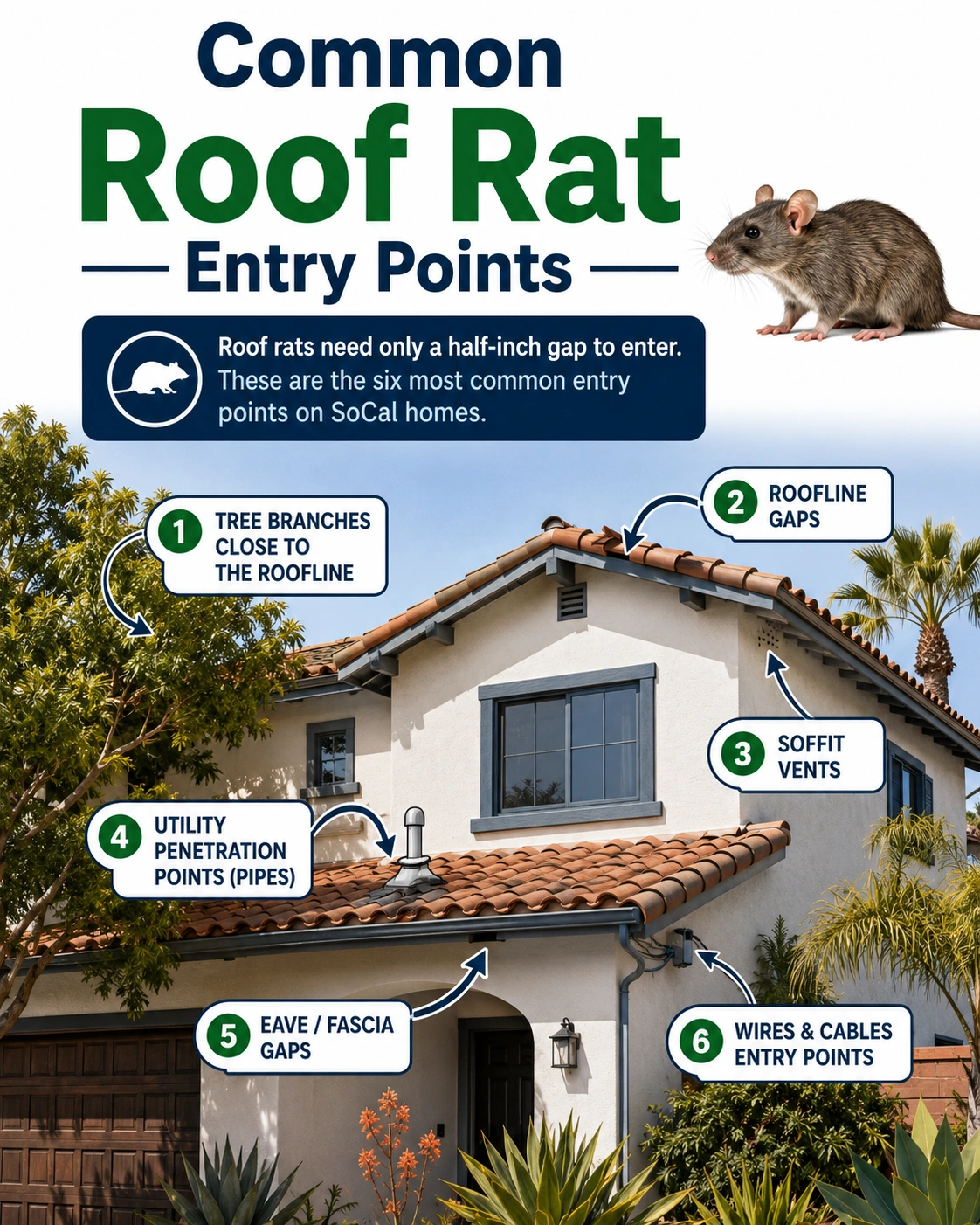
Walk the exterior and check where fascia meets the roof deck, around soffit vents, and at any utility penetration points. A half-inch gap is enough for a rat. Use galvanized hardware cloth (not foam or wood) for durable exclusion on vents and gaps.
03
Secure all food sources
Bird seed, pet food, fallen citrus, and outdoor compost bins are primary attractants. Store pet food in sealed metal or heavy plastic containers. Remove fallen fruit from the ground daily during spring and summer. Secure trash bin lids.
04
Seal garage door gaps
The bottom seal of garage doors deteriorates over time and is a primary Norway rat entry point. Check for daylight visible at the base when the door is closed. Replace worn door seals annually. Add a threshold seal if needed.
05
Remove clutter from attic and garage
Stored boxes, old insulation, and piled materials provide ideal nesting habitat. Minimizing clutter reduces nesting opportunities and makes it easier to spot droppings, gnaw marks, or other early signs during a self-inspection.
06
Do not use poison bait as your primary solution
Rodenticide bait kills rodents but does not seal entry points. Poisoned rodents often die inside wall voids or attics, creating odor problems and secondary pest attraction. Exclusion first, trapping second, bait only where necessary under professional guidance.
Common roof rat entry points on a Southern California home: roofline gaps, soffit vents, tree branches, utility penetrations
Roof rats need only a half-inch gap to enter. These are the six most common entry points on SoCal homes.

What professional rodent control actually involves

Most homeowners who call a pest professional have already tried traps and bait stations from the hardware store. Those tools are not wrong, but they address the symptom (the rodents inside) without solving the problem (how they are getting in). Professional rodent control is built around exclusion first.

A comprehensive professional program typically works in this order: a full inspection of the exterior and interior to identify all active entry points, nesting locations, and travel routes. Then a written exclusion plan that specifies every gap to be sealed and what material to use. Then trapping to remove existing rodents from the structure. Then a follow-up inspection to confirm the population is gone and no new entry has occurred. Finally, an ongoing monitoring program to catch any future activity early.

For attic infestations specifically, the process may also include attic cleanout: removing contaminated insulation, sanitizing the space, and replacing insulation where rodents have nested. This step is critical not just for hygiene but because old nesting material and urine trails continue to attract new rodents even after the original population is removed.

HOA and multi-unit properties Rodent exclusion in shared-wall properties (condos, townhomes, apartment complexes) requires coordination across the full structure. Sealing one unit’s entry points without addressing the building envelope simply moves the rodents into adjacent units. AG Pest works directly with property managers and HOAs to develop building-wide exclusion programs that address the structure, not just individual complaints.

Hearing something in your attic?

AG Pest provides free rodent inspections for homeowners across San Diego County, Orange County, and Riverside County. We identify entry points, locate nests, and explain your options with no pressure.

Request a Free Inspection
Or call us directly to schedule. Same-week availability in most service areas.

Frequently asked questions about rodent control in Southern California

How do I know if I have rats or mice?
The most reliable indicators are droppings and sounds. Rat droppings are 12 to 20mm long, tapered at both ends, and dark brown to black. Mouse droppings are much smaller (3 to 6mm), resembling dark rice grains. Rat activity tends to produce louder, slower movement sounds at night. Mice produce faster, lighter scurrying sounds. If you find gnaw marks, look at the size: rats leave marks about 4mm wide, mice leave smaller marks. When in doubt, a professional inspection is the fastest way to confirm the species, which matters because treatment approaches differ.
Why do I keep getting rodents even after treating?
Recurring infestations almost always mean the entry points were not sealed. Traps and bait remove the current population but do nothing to prevent the next one from entering. Roof rats in particular maintain territory and their offspring will return to the same structure. A lasting solution requires physical exclusion: identifying and sealing every entry point before trapping. In areas with high external rodent pressure (near canyons, open land, or ongoing construction) ongoing monitoring is also necessary because pressure from the outside does not stop.
Are rodents in the attic dangerous?
Yes, in several ways. Rodents chew electrical wiring, which is a documented cause of attic-origin house fires. They also damage HVAC ductwork, destroy insulation (reducing its thermal value), and contaminate attic spaces with droppings and urine. Health risks include hantavirus (rare but present in SoCal), leptospirosis from urine contamination, and salmonella. Additionally, dead rodents in wall voids attract secondary pests including flies, beetles, and in some cases, other rodents that feed on carrion. Early detection and treatment is significantly less costly and disruptive than a full attic cleanout after a major infestation.
Is spring really the worst time of year for rodents in SoCal?
Spring and late fall are the two peak windows. In spring, female rodents enter peak reproductive cycles and actively seek enclosed nesting spaces like attics and crawl spaces. The combination of breeding drive and warming temperatures makes March through May the highest-risk period for new attic infestations across San Diego, Orange County, and Riverside. A second spike typically occurs in late fall (October through November) as outdoor temperatures drop and rodents seek winter shelter indoors. Preventative treatment before these windows is significantly more effective than reactive treatment after an infestation is established.
How much does professional rodent control cost in Southern California?
A basic residential rodent treatment (inspection, trapping, initial exclusion) typically ranges from $200 to $500 depending on the size of the home and severity of the infestation. Full exclusion with materials (sealing all identified entry points) adds $300 to $800 or more depending on the number of gaps and accessibility. Attic cleanout and insulation replacement, when needed, ranges from $1,500 to $4,500 for a typical SoCal home. AG Pest Control offers free inspections so you receive an accurate quote before any work begins. Preventative programs cost significantly less than reactive treatment after an established infestation.
Do rodent problems differ between San Diego, Orange County, and Riverside?
Yes. San Diego County sees the highest year-round roof rat pressure, particularly in coastal and canyon-adjacent neighborhoods. Orange County’s mix of older residential areas and dense HOA communities creates different exclusion challenges, especially in shared-wall structures where rodents move between units. Riverside County’s rapid development has created significant displacement pressure, pushing rodents from open land into new housing tracts, and desert-adjacent communities also encounter pack rats (woodrats) not commonly seen in coastal counties. A licensed pest professional familiar with all three counties, like AG Pest Control, will tailor the approach to the specific species and conditions at your property.

AG

AG Pest Control — Pest Education Team

Southern California Licensed Pest Control Professionals

This article was reviewed and written by licensed pest control operators serving San Diego County, Orange County, and Riverside County. Founded in 1982, AG Pest Control has provided residential and commercial pest management across Southern California for over 40 years, specializing in rodent control, termite programs, wildlife management, general pest control, and palm care. Our technicians are licensed by the California Structural Pest Control Board (SPCB) and maintain current Continuing Education requirements. All recommendations reflect current Integrated Pest Management (IPM) best practices for Southern California rodent species and conditions.

CA SPCB Licensed Founded 1982 40+ Years in SoCal IPM Certified SD · OC · Riverside
How do I know if I have rats or mice?

The most reliable indicators are droppings and sounds. Rat droppings are 12 to 20mm long, tapered at both ends, and dark brown to black. Mouse droppings are much smaller (3 to 6mm), resembling dark rice grains. Rat activity tends to produce louder, slower movement sounds at night. Mice produce faster, lighter scurrying sounds. If you find gnaw marks, look at the size: rats leave marks about 4mm wide, mice leave smaller marks. When in doubt, a professional inspection is the fastest way to confirm the species, which matters because treatment approaches differ.

Why do I keep getting rodents even after treating?

Recurring infestations almost always mean the entry points were not sealed. Traps and bait remove the current population but do nothing to prevent the next one from entering. Roof rats in particular maintain territory and their offspring will return to the same structure. A lasting solution requires physical exclusion: identifying and sealing every entry point before trapping. In areas with high external rodent pressure (near canyons, open land, or ongoing construction) ongoing monitoring is also necessary because pressure from the outside does not stop.

Are rodents in the attic dangerous?

Yes, in several ways. Rodents chew electrical wiring, which is a documented cause of attic-origin house fires. They also damage HVAC ductwork, destroy insulation (reducing its thermal value), and contaminate attic spaces with droppings and urine. Health risks include hantavirus (rare but present in SoCal), leptospirosis from urine contamination, and salmonella. Additionally, dead rodents in wall voids attract secondary pests including flies, beetles, and in some cases, other rodents that feed on carrion. Early detection and treatment is significantly less costly and disruptive than a full attic cleanout after a major infestation.

Is spring really the worst time of year for rodents in SoCal?

Spring and late fall are the two peak windows. In spring, female rodents enter peak reproductive cycles and actively seek enclosed nesting spaces like attics and crawl spaces. The combination of breeding drive and warming temperatures makes March through May the highest-risk period for new attic infestations across San Diego, Orange County, and Riverside. A second spike typically occurs in late fall (October through November) as outdoor temperatures drop and rodents seek winter shelter indoors. Preventative treatment before these windows is significantly more effective than reactive treatment after an infestation is established.

How much does professional rodent control cost in Southern California

A basic residential rodent treatment (inspection, trapping, initial exclusion) typically ranges from $200 to $500 depending on the size of the home and severity of the infestation. Full exclusion with materials (sealing all identified entry points) adds $300 to $800 or more depending on the number of gaps and accessibility. Attic cleanout and insulation replacement, when needed, ranges from $1,500 to $4,500 for a typical SoCal home. AG Pest offers free inspections so you receive an accurate quote before any work begins. Preventative programs cost significantly less than reactive treatment after an established infestation.

Do rodent problems differ between San Diego, Orange County, and Riverside?

Yes. San Diego County sees the highest year-round roof rat pressure, particularly in coastal and canyon-adjacent neighborhoods. Orange County's mix of older residential areas and dense HOA communities creates different exclusion challenges, especially in shared-wall structures where rodents move between units. Riverside County's rapid development has created significant displacement pressure, pushing rodents from open land into new housing tracts, and desert-adjacent communities also encounter pack rats (woodrats) not commonly seen in coastal counties. A licensed pest professional familiar with all three counties, like AG Pest, will tailor the approach to the specific species and conditions at your property.

Leave a Reply

Your email address will not be published. Required fields are marked *

More From the blog

Argentine ant trail along a kitchen counter in San Diego — spring ant season in Southern California

Ant Control in San Diego

Pest Education · Southern California Ant Season in SoCal: What San Diego Homeowners Need to Know Right Now By the AG Pest Control Team ·

Read More »
Call Now Button