California’s Rabies Surge: What Southern California Homeowners Should Know About Bats (2026)
The California Veterinary Medical Association reported on Nov 7, 2026, that at least 368 rabid animals had been found in California this year, breaking a 28-year record. That count and the “28-year record” wording come from CVMA. The California Department of Public Health’s latest provisional table, covering Jan 1 through Oct 30, 2026, lists 389 rabid animals statewide, almost all of them bats. CVMA says the risk to the public remains low. This guide covers what that means for homes in San Diego, Orange and Riverside counties, and what to do if a bat gets inside. AG Pest has served Southern California since 1982.
What’s behind California’s record rabies year
The numbers so far in 2026
CDPH’s provisional table for Jan 1 through Oct 30, 2026, reports 389 rabid animals statewide: 364 bats, 21 skunks, 2 raccoons, 1 cat and 1 dog. These figures are provisional and will change as labs report more cases. CVMA’s Nov 7 post used a count of at least 368, which matches CDPH’s earlier table through Oct 14. This post uses the later CDPH count of 389 and credits CVMA for the record claim, and for the note that the last human death from rabies in California was in 2024.
Why bats make up almost every case
Bats account for 364 of the 389 reported cases, about 93 percent. In San Diego County, bats test positive for rabies more frequently than any other animal. A bat can carry the virus without looking obviously sick, and bites or scratches may be too small to notice. San Diego County also states that people cannot get rabies just by touching or being near a rabid animal. The concern is direct contact, especially a bite or scratch, or a bat found in a room where someone was sleeping. If that happens, call your doctor and your county public health department or animal control.
“The risk to the public remains low.”
California Veterinary Medical Association, Nov 7, 2026
Rabid bats in San Diego, Orange and Riverside counties
County counts for 2026
Every confirmed case in San Diego, Orange and Riverside counties in the 2026 CDPH table has been a bat. The three counties account for 103 of the 389 statewide cases, about 26 percent of the total.
| County | Confirmed cases (all bats) |
|---|---|
| San Diego County | 44 |
| Orange County | 32 |
| Riverside County | 27 |
| Three-county total | 103 |
| California statewide | 389 |
Source: California Department of Public Health, Reported Animal Rabies by County and Species, 2026, provisional, Jan 1 through Oct 30, 2026.
No skunks or raccoons are listed as rabid in these three counties in the 2026 table. Statewide, CVMA also reported two rabid raccoons in Los Angeles County, the first there in over 50 years. Those cases are outside AG’s service area and are included here only as context for the statewide picture.
How 2026 compares with 2024
CDPH’s provisional 2024 table, covering Jan 1 through Nov 22, 2024, listed 11 cases in San Diego County, 12 in Orange County and 12 in Riverside County, for a total of 35, and 169 statewide. This year’s three-county count of 103 is roughly three times the 2024 figure, with weeks still left in the year. All comparisons in this post use CDPH provisional data.
Bats are still good neighbors
A higher count of rabid bats does not mean bats should be treated as a threat. San Diego County notes that the county has more than 20 bat species, and that they eat insects such as mosquitoes. Bats are beneficial and protected. The goal is keeping them out of living spaces, not harming them. Most bats are not rabid. Still, no bat should be handled with bare hands, whether it is alive or dead.
Are bats in your attic a rabies risk?
A bat in an attic is not automatically a rabies exposure, and most bats are not rabid. The risk comes from close contact: a bite, a scratch, or a bat found in a room where a person was sleeping. San Diego County says bat bites and scratches may not be noticeable, and that sleeping in the same room as a bat presents a potential risk of exposure. If any of those situations apply, talk with your doctor and your county public health department or animal control.
How bats get into Southern California homes
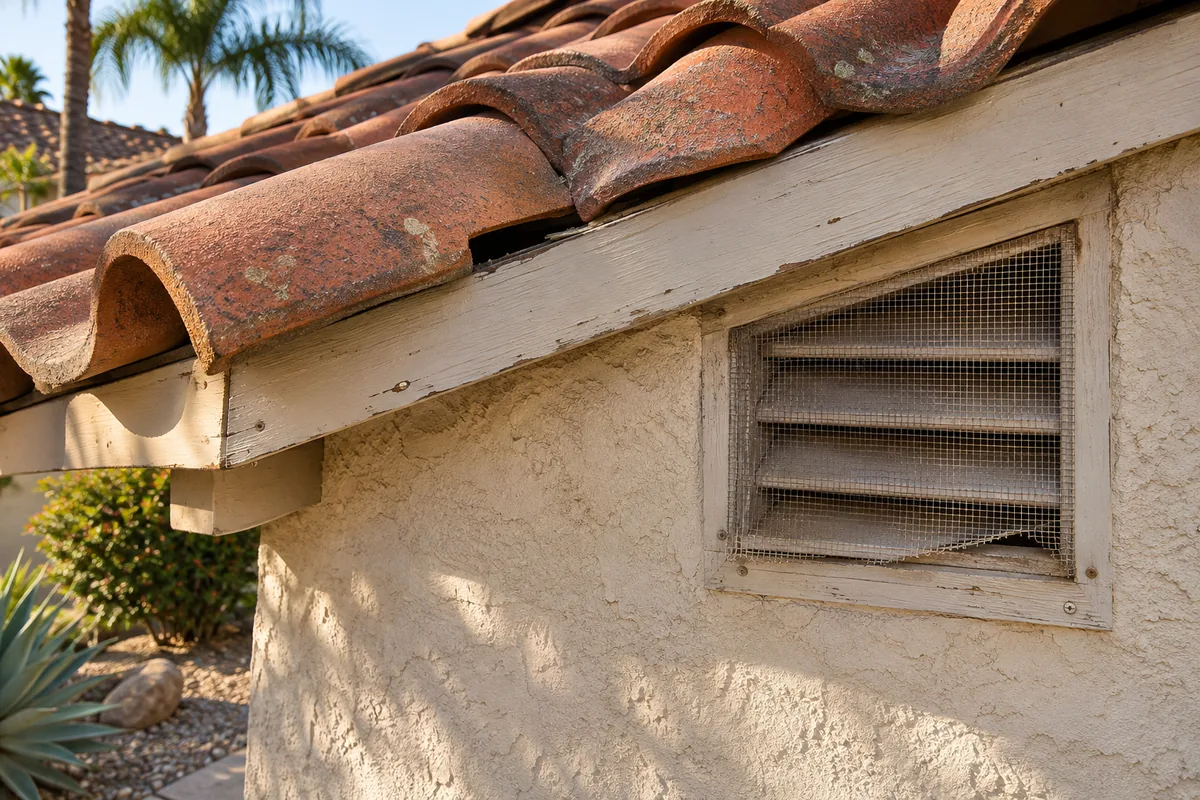
Common entry points on local homes include gaps under clay tile roofs, attic and gable vents, open eaves, gaps in siding, and uncapped chimneys. Even a small opening can be enough. The California Department of Fish and Wildlife notes that bat roosts can be in attics, siding, roofs and outbuildings. The same gaps that let rodents in can also let bats in. For more on those openings, see What To Do With A Bat in Your Orange County Home and this rodent-proofing guide for older San Diego homes.
Signs you have bats
Homeowners often notice a pattern rather than a single event:
- Scratching, crawling or chirping in the attic or walls around dusk
- Droppings (guano) on siding, near vents or in the attic
- Dark stains or smudges around a roofline opening
- A musky odor in a closed attic or garage
- Bats leaving at dusk, or a single bat indoors
If you see a bat inside, do not try to catch it. Close off the room and call for help, as outlined below. Other wildlife can use the same spaces; see common fall wildlife in San Diego and winter wildlife removal.
What to do if you find a bat in your house
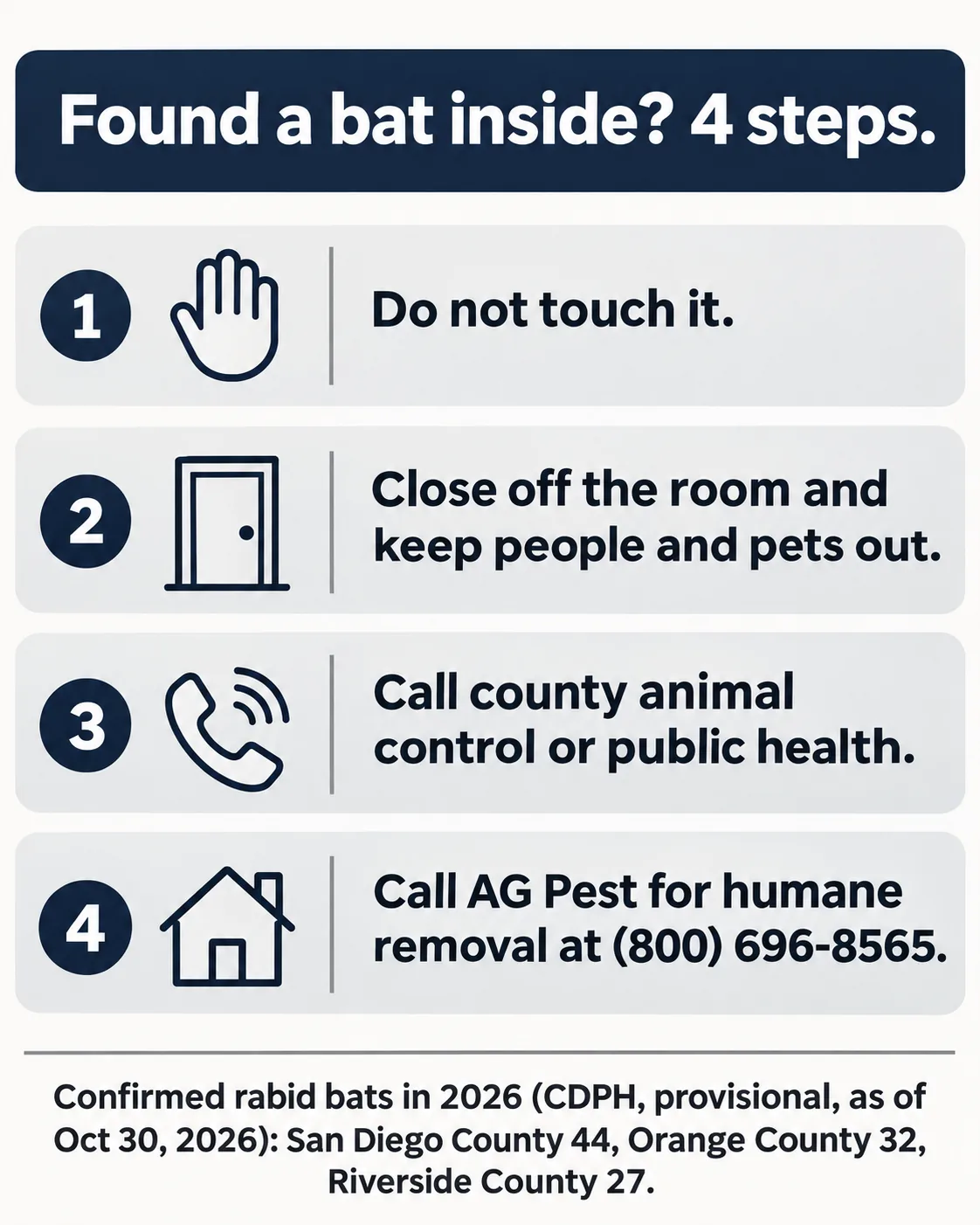
Don’t touch it; keep people and pets out and close off the room
Orange County’s guidance is a good rule in all three counties: if bats are seen inside the house or another structure, close off the area and contact animal control. Once the bats have been removed, close off any openings that allowed them in. Do not shoo a bat with a towel, a broom or your hands, and keep pets in another room.
If you’re sure no one had contact with the bat
If a single bat is flying around inside and you’re certain no one touched it, no pet touched it, and no one was asleep in the room, the California Department of Fish and Wildlife says it will usually find its own way out. Close the doors to other rooms, open the windows and outside doors in that room, turn off the lights and ceiling fans, and keep a quiet, safe distance while it leaves. If it doesn’t leave, or if anyone may have had contact with it, including a sleeping person, a young child or a pet, don’t let it go. Keep it in the room and call county animal control or public health so it can be tested if needed.
Who to call in your county
Start with your county animal control or public health department, especially if a person or pet may have had contact with the bat:
- San Diego County: Epidemiology Unit, (619) 692-8499
- Orange County: OC Animal Care, (714) 935-6848. For a possible exposure, OC Health Care Agency Communicable Disease Control, (714) 834-8180
- Riverside County: Riverside County Animal Services, (951) 358-7387
Riverside County Animal Services does not trap or capture healthy wildlife and does not respond to nuisance wildlife calls. The county refers residents to a wildlife removal service. If there may have been contact, call animal control before anyone tries to let the bat go. County staff can advise on whether the animal should be kept for testing. That decision belongs to public health, not to a blog post.
If anyone was bitten, scratched or slept in the room
Wash the area with soap and water, then call your doctor and your county public health department or animal control. This post does not offer medical advice. Your doctor and local public health officials are the ones who can tell you the next step.
Skunks, raccoons and other wildlife: keeping your property less inviting
What the CDPH data says
Statewide, the provisional 2026 table lists 21 rabid skunks and 2 rabid raccoons. None of those skunk or raccoon cases are in San Diego, Orange or Riverside counties this year. In the CDPH table, skunk positives are concentrated in Northern California and Sierra counties, not in AG’s three-county service area. That does not mean local skunks and raccoons are risk-free. San Diego County still lists them among the wild mammals that can carry rabies, so people and pets should not approach them. If raccoons have already moved in, see what to do if you have a raccoon infestation.
Simple prevention
A few habits make a property less inviting to bats and other wildlife:
- Bring pet food inside and do not leave bowls out overnight
- Keep trash lids closed and cans upright
- Trim tree branches that reach the roof
- Screen attic, gable and crawl space vents
- Seal small gaps at the roofline when you can do so safely, or call a professional
The same checklist helps against rodents and urban wildlife. See how to protect your San Diego property from rodents and urban wildlife intruders.
Keep pets’ rabies vaccinations current
California requires dogs to be vaccinated against rabies. County health departments also recommend keeping cats current. San Diego County’s rabies page is a clear starting point. If a pet may have had contact with a bat or other wildlife, call your veterinarian and county animal control.
How AG Pest handles wildlife removal
AG Pest provides a humane live capture and removal service for nuisance animal pests and wildlife invaders in San Diego, Orange and Riverside counties. The work is completed in accordance with State and Federal trapping regulations, and AG’s trappers are licensed by the California Department of Fish and Wildlife. Animals listed on AG’s wildlife pages for this service include bats, skunks, raccoons, opossums and snakes.
- Wildlife control in San Diego County
- Wildlife control in Orange County
- Wildlife control in Riverside County
For a broader look at the options, see what methods of wildlife control are available. To talk through a specific property, request a quote or contact AG Pest.
Frequently asked questions
Call AG Pest for humane wildlife removal
Hearing scratching in the attic at dusk, or spotted a bat in the house? Call AG Pest at (800) 696-8565 for humane wildlife removal in San Diego, Orange and Riverside counties.
Request a QuoteSources
- California Veterinary Medical Association, LinkedIn post, Nov 7, 2026: At least 368 rabid animals have been found in California
- California Department of Public Health, Reported Animal Rabies by County and Species, 2026 (provisional, Jan 1 through Oct 30, 2026)
- California Department of Public Health, Reported Animal Rabies, 2024 (PDF) (provisional, Jan 1 through Nov 22, 2024)
- County of San Diego HHSA, Rabies
- Orange County Health Care Agency, Bat found in Rancho Santa Margarita tests positive for rabies (January 2026)
- Riverside County Department of Animal Services, Health officials report an increase in rabid bats (Oct 29, 2025), and Wildlife
- California Department of Fish and Wildlife, Report a Bat Colony