Managing pest activity across shared walls, common areas, and dozens of units is a different challenge than treating a single-family home. For HOA board members and property managers in Southern California, the standard residential model — wait for a complaint, call a vendor, treat the problem — breaks down quickly when your units share plumbing chases, wall voids, laundry rooms, and parking structures. This guide covers what a program-level approach to pest control actually looks like, why it protects property values and board liability, and what separates vendors who can handle commercial accounts from those who can’t.
Why pest management is different in HOAs and multi-unit communities
Residential pest control is built around a simple model: one property, one decision-maker, one treatment. That model falls apart in a multi-unit or common-interest community almost immediately. In an HOA or apartment complex, pest pressure doesn’t respect unit boundaries. A German cockroach infestation in unit 104 isn’t a unit 104 problem — it’s a building problem on a delay.
The structural differences that make multi-unit pest management harder:
- Shared infrastructure. Plumbing chases, electrical conduits, attic spaces, and wall cavities connect units that appear separate. Pests move through these pathways invisibly and continuously.
- Distributed entry points. Every unit door, window, patio, and balcony is a potential entry point. A single property may have 50–300+ individual access points, compared to a dozen or fewer in a single-family home.
- Decision-making friction. Reactive vendor callouts require board or management approval, budget allocation, and resident notification — all of which take time pests don’t wait for.
- Liability exposure. An HOA or property management company that receives documented pest complaints and fails to act appropriately faces real legal exposure, particularly for conditions like bed bugs that California law specifically addresses.
- Documentation requirements. Insurance, local health departments, and courts all expect records. A reactive callout leaves no paper trail. A program-level approach generates inspection reports, service records, and treatment logs automatically.
California law and bed bugs
Under California Civil Code §1941.1 and the Bed Bug Disclosure Requirements (AB 551), landlords and HOAs have specific obligations to investigate and address bed bug complaints promptly, provide written disclosures about bed bug history, and not rent units with known active infestations. Failure to comply creates liability that documented pest control programs are specifically designed to reduce.
The unit-to-unit spread problem
The most common question property managers ask when they start understanding multi-unit pest dynamics is: “How fast does this happen?” The answer depends on the pest — but in most cases, faster than the complaint-and-respond model can keep up with.
Each of the four primary spreading pests in SoCal multi-unit properties uses a different pathway — which is why effective programs address all of them simultaneously rather than responding to each complaint in isolation.
German Cockroach
Route: Plumbing & walls
The fastest-spreading structural pest. Moves through drain pipes, wall voids, and shared utility chases. One untreated unit can re-infest three adjacent units within 30–60 days.
Bed Bug
Route: Hallways & furnishings
Spread via shared laundry, hallway foot traffic, and second-hand furniture. A single infested unit in a high-turnover building can seed multiple floors before detection.
Roof Rat / Norway Rat
Route: Attic, exterior, landscaping
Enter through shared landscaping, rooflines, and utility gaps. Common in both coastal SD and inland OC/Riverside communities. Nest in attic spaces shared across units.
Argentine Ant
Route: Exterior perimeter
Form super-colonies across entire city blocks. Pervasive in San Diego and OC coastal communities. Enter through any gap at the foundation line or utility penetration.
The mechanics matter because they determine the solution. Treating one unit for cockroaches while leaving adjacent units uninspected is not treatment — it’s displacement. A well-designed commercial program accounts for migration pathways from the start.
AG Pest note: In multi-unit properties, the unit that reports the problem is almost never the source. Our inspection protocol for commercial accounts always includes adjacent units and common areas as part of the initial assessment — not as an add-on.
Most common pests in SoCal multi-unit properties
Southern California’s climate — warm year-round, dry summers, mild winters — means there is no meaningful pest die-off season. The pests that would go dormant in a Chicago winter or a Seattle fall remain active here through January and February. For property managers, this means commercial pest management is a 12-month responsibility, not a seasonal one.
-
1
German cockroaches — The primary structural pest in attached multi-unit housing. Infestations cluster near kitchens and bathrooms and spread aggressively through shared plumbing. A single egg case produces up to 40 nymphs; populations double in weeks under warm conditions.
-
2
Bed bugs — Elevated risk in high-turnover communities, furnished units, and properties near hospitality corridors. San Diego’s tourism industry and Riverside’s proximity to major travel routes both increase exposure. Require specialized protocols distinct from general pest treatment.
-
3
Roof rats and Norway rats — Prolific in urban and suburban communities throughout SD, OC, and Riverside. Enter via landscaping, fruit trees, rooflines, and utility openings. Cause structural damage, create health code concerns, and are particularly problematic in communities with mature trees or dense groundcover.
-
4
Argentine ants — Ubiquitous in coastal Southern California. Form massive super-colonies that extend across multiple properties. Entry control at the perimeter is the only effective management strategy — interior-only treatment without exterior service provides no lasting results.
-
5
Subterranean and drywood termites — Southern California has two economically significant termite species, and both are active in multi-unit structures. Subterranean termites attack foundation wood and require soil treatment; drywood termites infest attic framing and require fumigation or localized treatment. Both carry significant structural risk and require licensed inspection and reporting.
-
6
Seasonal invaders — Earwigs, silverfish, crickets, and occasional spiders increase in volume during late summer and fall as outdoor temperatures drop. Less structurally damaging but generate high complaint volume among residents. Addressed through perimeter treatment and moisture source identification.
Managing pest control across multiple units?
AG Pest Control serves HOAs and property management companies throughout San Diego, Orange County, and Riverside County. Program pricing, documentation included.
Request a Commercial Assessment
We’ll assess your property and provide a program proposal — no commitment required.
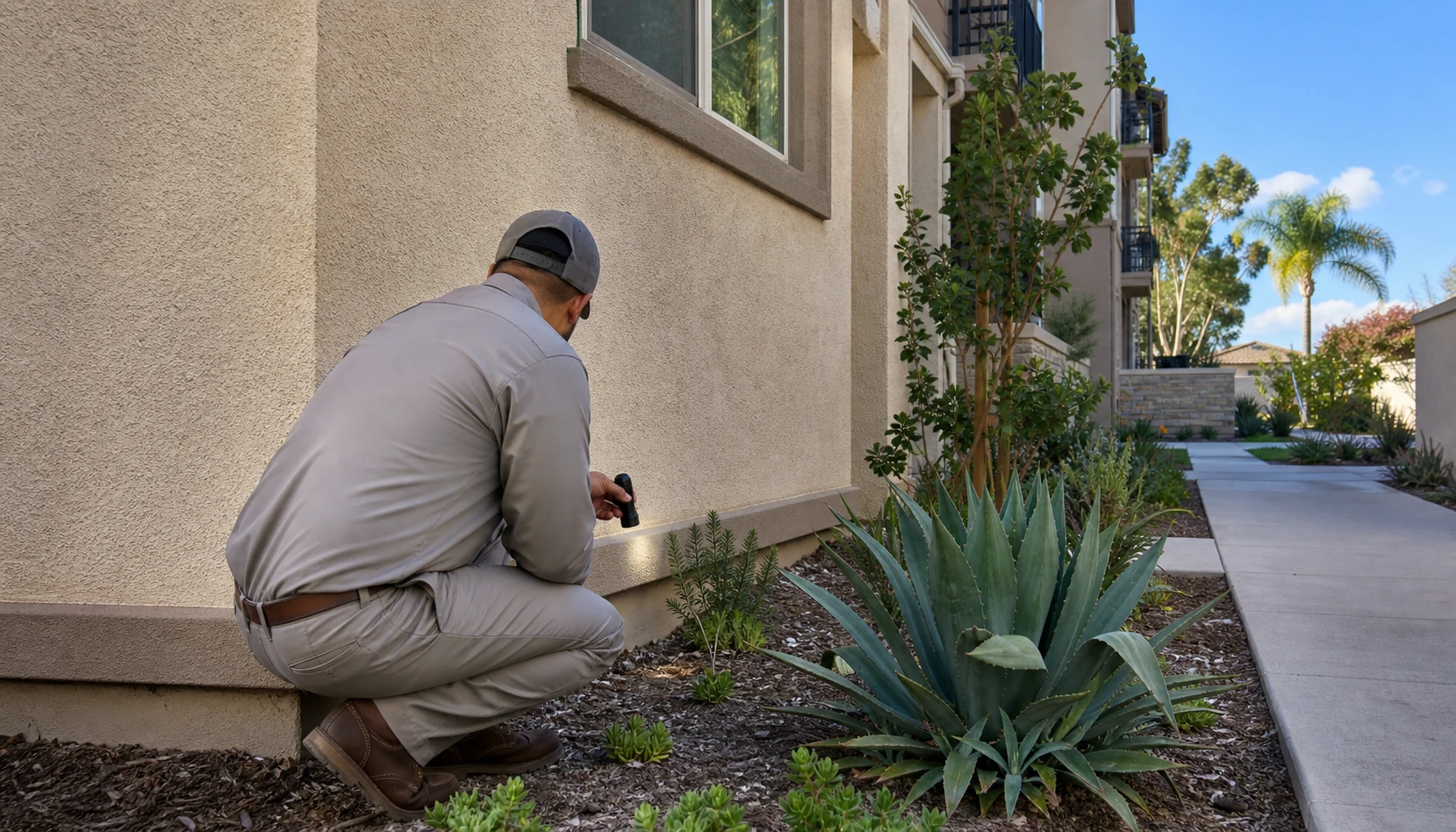
Scheduled exterior inspections and foundation treatments are the cornerstone of every effective commercial pest control program in SoCal.
What a commercial pest control program covers
A program-level service for an HOA or multi-unit property is structurally different from a residential subscription. The scope is broader, the documentation requirements are higher, and the service cadence is built around the property’s risk profile — not a generic quarterly schedule.
Here’s what a comprehensive commercial program for a SoCal multi-unit community typically includes:
🔍
Exterior Perimeter Treatment
Foundation barriers, entry point sealing, and landscape border treatment targeting ant colonies, rodent harborage, and perimeter-invading species. The first line of defense for any structure.
🏢
Common Area Inspection & Service
Lobbies, mailrooms, laundry facilities, pool areas, parking structures, and trash enclosures. These are primary harborage and travel points and require dedicated attention separate from unit service.
🏠
Interior Unit Access Protocols
Coordinated entry scheduling for unit-level treatment with appropriate resident notification. Includes protocols for occupied vs. vacant units, which require different treatment approaches.
📡
Monitoring Station Network
Interior and exterior rodent bait stations and cockroach monitoring traps placed at critical points across the property. Checked at every service visit; catch data trends identify pressure before it becomes infestation.
📋
Service Documentation & Reports
Written service reports after every visit, accessible to the property manager and HOA board. Documents treatment locations, products used, pest activity observed, and recommended corrective actions.
📞
Between-Visit Response
Resident complaints don’t wait for scheduled visits. A commercial account includes priority response for reports between scheduled services — addressing new activity before it spreads to adjacent units.
Termite scope is separate. General pest control programs (ants, cockroaches, rodents, seasonal invaders) and termite inspection/treatment are different license categories under California law. A CA SPCB-licensed company can provide both — but confirm your vendor holds licenses in both Branch 2 (general pest) and Branch 3 (termite and wood-destroying organisms) if termites are a concern.
Reactive vs. preventative: cost and liability comparison
The most consistent objection to program-level pest control from HOA boards is cost. It’s a reasonable question: why pay for scheduled service when you could just respond to problems as they arise? The answer is in what reactive treatment actually costs — not just in vendor fees, but in total liability exposure.
❌ Reactive approach
- ▸ Multiple complaint calls per month to management
- ▸ Per-unit billing, unpredictable monthly spend
- ▸ No documentation trail for board or insurance
- ▸ Delays between report and treatment allow spread
- ▸ Board liability for failure to act on known conditions
- ▸ Higher per-incident cost for emergency treatment
- ▸ Resident satisfaction complaints, potential lease issues
✓ Preventative program
- ▸ Scheduled service with predictable program pricing
- ▸ Fixed monthly or quarterly budget line item
- ▸ Service reports on file for every visit
- ▸ Unit-to-unit spread interrupted before escalation
- ▸ Documented proactive care reduces board exposure
- ▸ Lower total cost across the property annually
- ▸ Residents notice fewer pest complaints; satisfaction improves
The cost comparison isn’t just about vendor invoices. An HOA that receives a written bed bug complaint, fails to document a response, and faces a habitability claim from a tenant is looking at legal costs that dwarf years of preventative service fees. In California, the question is rarely “can we afford a program?” — it’s “can we afford not to have one?”
What boards should know about pest-related liability
California courts have found HOAs liable for pest conditions that affected habitability when the association was aware of the problem and failed to take timely, documented action. Documented service reports from a licensed vendor are among the most effective tools for demonstrating reasonable care. Your property manager and legal counsel should be aligned on what constitutes adequate response to a resident pest complaint.

Regular common-area inspections and documented service reports are what separate a program-level vendor from a one-time callout service.
Questions to ask your pest control vendor
Not every pest control company that handles residential accounts is equipped to manage an HOA or multi-unit commercial property. The scope, documentation requirements, insurance obligations, and resident coordination involved in a commercial account require specific experience. Before signing a program contract, use this checklist:
-
✓
Are you licensed by the California Structural Pest Control Board? Confirm Branch 2 (general pest) and Branch 3 (termites) licenses as needed. You can verify at pestboard.ca.gov.
-
✓
Do you have experience with HOA or multi-unit commercial accounts in SoCal? Ask for references from comparable properties — similar size, unit count, and pest profile.
-
✓
What documentation is provided after each service visit? Written reports should include service areas covered, products applied, pest activity observed, and any corrective recommendations. Digital reports accessible to management are a significant operational advantage.
-
✓
How do you handle resident-reported infestations between scheduled visits? What is the response time commitment? Is between-visit response included in the program or billed separately?
-
✓
Do you carry general liability and errors & omissions insurance? Request certificates of insurance before signing. COIs should name the HOA or property management company as an additional insured if required by your governing documents.
-
✓
What is your protocol for pest treatment in occupied units? California law and most HOA governing documents require advance notice to residents. Confirm the vendor’s notification procedure and whether resident access coordination is their responsibility or management’s.
-
✓
Do you have a separate bed bug protocol? Bed bugs require a specialized response distinct from general pest control — different products, different treatment methodology, and specific compliance documentation under California law. Confirm the vendor has a defined bed bug procedure.
-
✓
How do you handle restricted-use pesticides in occupied buildings? Some treatments require resident evacuation or re-entry waiting periods. Understand the full operational impact before committing to a service approach.
San Diego, Orange County & Riverside: market context
SoCal’s three major markets each have distinct pest pressure profiles driven by climate, housing stock, density, and population turnover. A program designed for a newer Temecula townhome complex looks different from one serving a 1970s-era garden apartment community in Anaheim. Here’s what property managers in each county should know:
San Diego County
Year-round pressure, dense urban core
Argentine ant pressure is among the highest in the nation along SD’s coastal corridor. Downtown, Mission Valley, and Chula Vista communities face elevated bed bug exposure due to high residential turnover and proximity to hospitality corridors. Eastern SD communities see more rodent pressure and occasional drywood termite activity. Military-adjacent communities in National City, Oceanside, and Spring Valley experience higher-than-average unit turnover, which increases bed bug and cockroach introduction risk.
Orange County
Dense inventory, older HOA communities
Many of OC’s largest HOA communities were built in the 1970s–90s, with aging infrastructure that creates more entry points for pests. Anaheim, Santa Ana, Garden Grove, and Fullerton have some of the highest-density multi-unit housing in the region, with correspondingly complex pest management needs. Coastal communities from Newport Beach to Laguna face persistent Argentine ant pressure. Subterranean termites are active across the county and require vigilance in older wood-frame structures.
AG Pest serves Orange County communities with dedicated commercial programs.
Riverside County
Rapid growth, desert-adjacent pressure
The Inland Empire has seen some of the fastest HOA community growth in California. Temecula, Murrieta, and the Coachella Valley have large, newer communities whose desert-adjacent locations introduce unique pests — black widows, scorpions, and occasional rattlesnake encroachment that while not technically “pest control,” affects program scope. Rodent pressure is significant in communities near undeveloped land.
Our Riverside County commercial programs account for this expanded pest profile.
Frequently asked questions
What does a commercial HOA pest control program typically include?
⌄
A comprehensive commercial program for a multi-unit community typically covers: scheduled exterior perimeter treatment, common area inspection and service (lobbies, laundry, trash, parking, pool areas), interior unit access on a coordinated schedule, monitoring station placement and regular check, and written service documentation after each visit. Most programs also include between-visit response for resident-reported activity at no additional per-callout charge. The specific scope depends on your property size, unit count, age of the structures, and pest history — which is why an initial commercial assessment is the right first step.
Who is responsible for pest control in an HOA — the association or the unit owners?
⌄
This is determined by your CC&Rs and the specific pest condition involved. Generally, the HOA is responsible for pest control in common areas and shared structural components (attic spaces, wall cavities, exterior). Individual unit owners are typically responsible for pest conditions that originate within their unit and are limited to that unit. The critical gray area: when a pest condition originates in common areas or spreads from unit to unit through shared infrastructure, the association typically bears responsibility for investigation and remediation. Your association’s legal counsel should be involved in cases where liability or cost allocation is disputed. A licensed pest control company can document the origin and extent of an infestation, which is often essential for resolving these disputes.
How quickly can pests spread from one unit to neighboring units?
⌄
Faster than the complaint-and-respond model can address. German cockroaches can move from one unit to three adjacent units within 30 to 60 days under warm SoCal conditions. Bed bugs spread more slowly but are much harder to detect and eradicate once established across multiple units — a single infested unit in a high-turnover building can seed multiple floors before anyone reports symptoms. Argentine ants don’t spread “unit to unit” in the traditional sense — they form super-colonies that can cover an entire block, making perimeter control the only effective strategy. Rodents move through attic spaces and wall voids continuously once established. This is why program-level service with regular perimeter and common area treatment interrupts spread before units report individual infestations.
How often should HOAs and apartment communities schedule pest control service?
⌄
For most SoCal multi-unit properties, monthly exterior service is the minimum that provides meaningful control continuity, given the year-round pest pressure here. Higher-risk properties — those with active rodent history, dense landscaping, proximity to restaurant or food service operations, or high resident turnover — typically benefit from bi-monthly interior common area service in addition to monthly exterior treatment. In Southern California, quarterly service alone is rarely sufficient for multi-unit commercial properties; the warm climate keeps pest populations active in months where they would be dormant in other states, meaning gaps in service cadence produce gaps in control.
What documentation should a pest control provider give to an HOA after each service?
⌄
At minimum: a written service report for each visit documenting the date, technician name and license number, service areas covered, products applied (including EPA registration numbers and application rates), pest activity observed, and any recommended corrective actions. For commercial accounts, this documentation serves multiple functions: it gives the property manager and board evidence of proactive care, provides the baseline for tracking pest pressure trends over time, and creates a legally defensible record in the event of a habitability complaint or insurance claim. Digital reports that can be archived and retrieved by unit or date are preferable to paper receipts.
Is preventative pest control more cost-effective than per-incident reactive treatment?
⌄
In almost every multi-unit scenario, yes — and the margin is larger than most boards expect when the full cost picture is considered. Reactive treatment is billed per callout, per unit, often at emergency or priority rates. A single German cockroach outbreak that has spread to 6–8 units before detection can cost significantly more to resolve than a full quarter of program service for the entire property. Add bed bug remediation costs (which can run into thousands of dollars per affected unit when fumigation or heat treatment is required) and the liability and legal costs associated with undocumented pest complaints, and the business case for a preventative program becomes straightforward. We’re happy to walk through the numbers specific to your property size and pest history.
Does AG Pest provide HOA-specific reporting for board meetings?
⌄
Yes. For commercial program accounts, we provide written service reports after every visit that are formatted to be shared directly with board members or included in management reports. For properties that want quarterly trend summaries — showing pest activity levels, treatment history, and any patterns or emerging concerns across the property — we can provide those as part of the account management relationship. HOA boards that want to demonstrate proactive pest management to homeowners find these summaries useful both for documentation and for setting expectations with residents about what the program is doing on their behalf.
AG
AG Pest Control — Pest Education Team
Southern California Licensed Pest Control Professionals
This article was reviewed and written by licensed pest control operators serving HOAs, property management companies, and commercial accounts throughout San Diego, Orange County, and Riverside County. Founded in 1982, AG Pest Control has provided residential and commercial pest management across SoCal for over 40 years. Our commercial division serves multi-unit communities ranging from small condo associations to large-scale HOA developments, with specialized knowledge of California’s pest disclosure requirements, SPCB licensing obligations, and the unit-to-unit spread dynamics unique to attached housing. All technicians hold current California Structural Pest Control Board licenses and are trained in IPM-first protocols consistent with CDFA and DPR guidelines.
CA SPCB Licensed
Founded 1982
40+ Years SoCal
HOA & Commercial Specialists
IPM Certified
Branch 2 & 3 Licensed
Ready to protect your community with a program that actually works?
AG Pest Control provides commercial pest management programs for HOAs and property managers across San Diego, Orange County, and Riverside County. Documentation included. Free property assessment.
Request a Commercial Assessment
Questions? Our commercial team is happy to walk through your property’s specific needs.