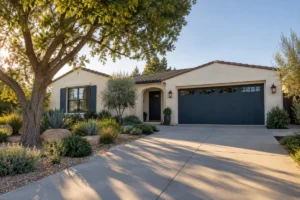
Drywood Termite Swarm Season in Southern California: What September–November Swarms Actually Mean
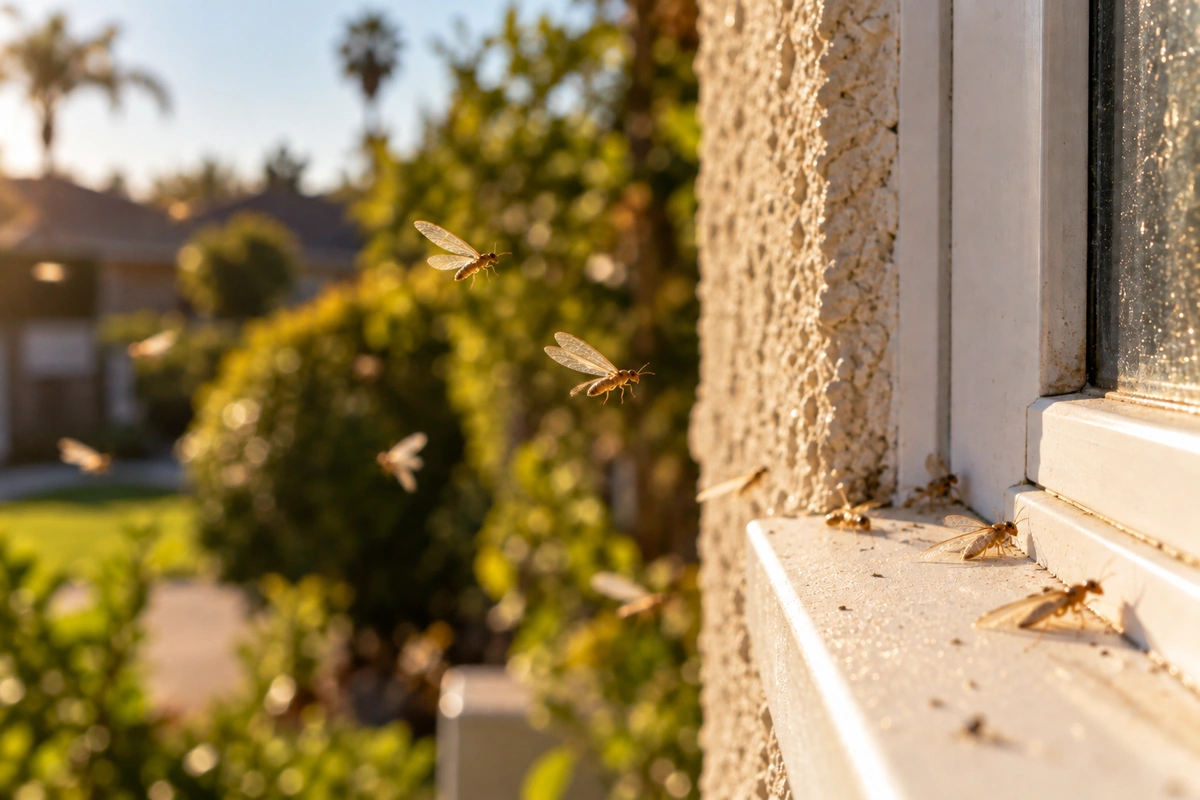
Every fall in Southern California, on a hot dry afternoon — often during a Santa Ana wind event — clouds of winged insects appear around homes, patios, and light fixtures. These are western drywood termite swarmers, and they fly by day between September and November. A swarm doesn’t automatically mean your house is infested. But it does mean a mature colony is nearby, and it’s the clearest, cheapest warning signal a property owner ever gets. Here’s how to read it.
When do drywood termites swarm in Southern California?
Western drywood termites (Incisitermes minor) swarm during the day, typically between September and November, with the heaviest activity in September and October. Swarms are usually triggered by hot, dry conditions — which in our region means the Santa Ana winds. That’s why a single warm, windy October afternoon can produce swarms across an entire neighborhood at once.
This is the opposite of what most people expect. Subterranean termites in other parts of the country swarm in spring, after rain. Our dominant structural termite swarms in the fall, in the heat, in the middle of the day. If you’ve been watching for termites in April, you’ve been watching the wrong season. (See how this fits the broader picture in our fall pest control guide.)
| Month | Swarm activity | Typical trigger | What to do |
|---|---|---|---|
| September | Peak | First hot, dry days | Photograph swarms; note the location |
| October | Peak | Santa Ana wind events | Book an inspection if swarms are at the house |
| November | Active | Late warm spells | Check sills and baseboards for pellets |
| Dec–Aug | Low | — | Colonies still feeding; damage continues silently |
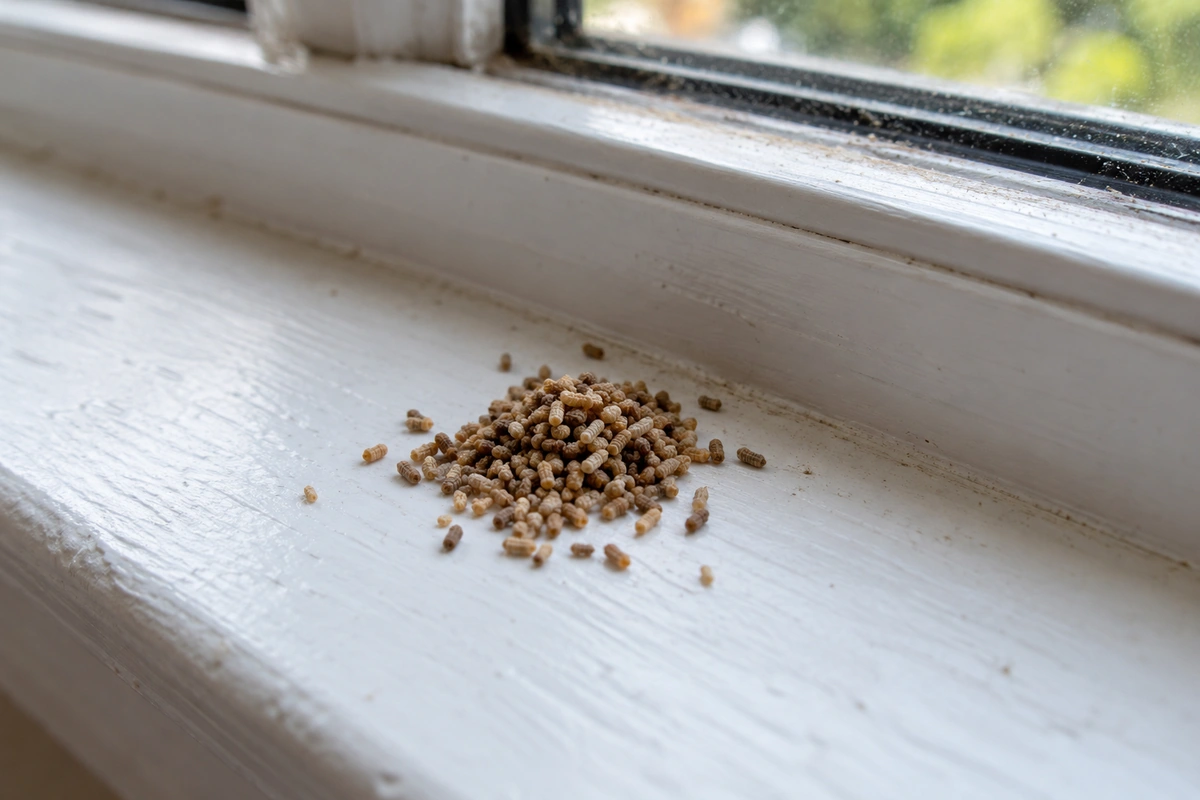
Six-sided fecal pellets on a sill or baseboard are the most reliable at-home sign of a drywood termite colony.
What a swarm actually means (and what it doesn’t)
Swarmers are winged reproductives — alates — leaving a mature colony to mate and start new colonies as founding kings and queens. A colony has to reach a certain age and size before it produces them at all, so their presence tells you an established colony exists somewhere within flight range.
How far is flight range? Drywood termites are poor fliers and rely heavily on the wind. Weak fliers rarely travel more than about ten feet from the nest. Better fliers may manage a hundred feet, and the strongest can reach a few hundred feet in favorable wind. Practically, that means:
The second scenario is the one that matters. Swarmers shed their wings shortly after flight, so a scatter of small identical translucent wings on an interior sill, in a bathtub, or along a windowsill track is one of the strongest indicators of a colony inside the structure.
Termite swarmers vs. flying ants: how to tell in three seconds
Fall also brings winged ants, and most “termite” reports we get in September turn out to be one or the other. Three features separate them, and you can check all three from a phone photo.
- Wings. Termite: four wings, all the same length, extending well past the body. Flying ant: front wings noticeably longer than the back pair.
- Waist. Termite: straight, thick, no pinch — the body looks like one continuous tube. Ant: a sharply pinched, narrow waist.
- Antennae. Termite: straight and beaded, like a tiny string of pearls. Ant: clearly bent at an elbow.
The 6 signs of a drywood termite colony
- Fecal pellets (frass). Small, hard, six-sided pellets the color of the wood being eaten, often in neat little piles below a kick-out hole. This is the single most reliable at-home sign.
- Discarded wings. Piles of identical translucent wings on sills, in tubs and sinks, or in spider webs near windows.
- Kick-out holes. Tiny round holes, roughly pinhead sized, in wood trim, eaves, fascia, or furniture — where the colony pushes pellets out.
- Blistered or rippled wood. Paint or veneer that looks bubbled, wavy, or slightly sunken, because the termites have eaten the wood just beneath the surface.
- Hollow sound. Tap along baseboards, door frames, window trim, and eaves. A papery or hollow tone where neighboring wood sounds solid is a flag.
- Sticking doors and windows. Damaged wood swells and distorts. If a door or window that always worked suddenly binds — with no weather explanation — it’s worth checking.
County by county: where fall termite pressure is highest
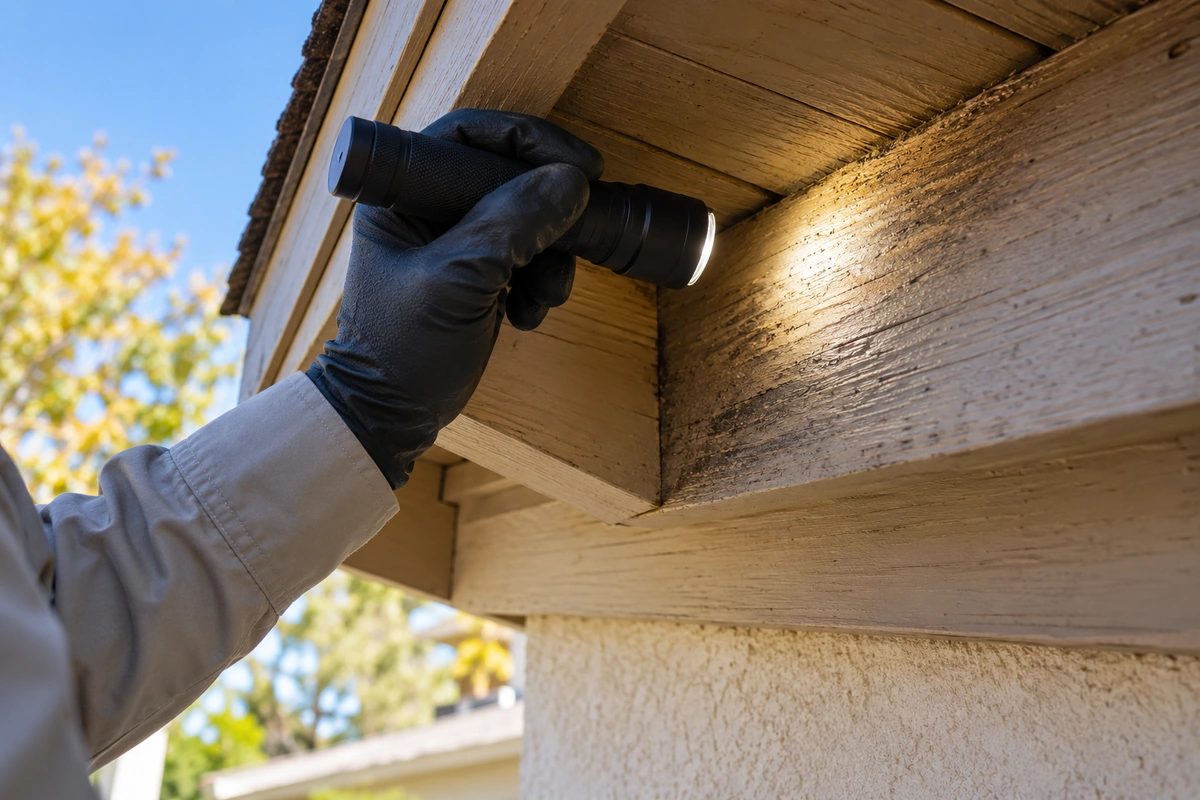
A structural inspection maps every area of activity — which is what determines whether a local treatment or a whole-structure approach is appropriate.
For HOAs, property managers & commercial buildings
Fall swarm season is a different problem at scale. In a townhome community, an apartment complex, or a strip of attached commercial units, drywood termites don’t respect property lines — and short flight distances between adjacent structures mean an untreated building will reseed its neighbors year after year.
What that means practically for boards and managers:
- Treat the community, not the complaint. Unit-by-unit reactive treatment in an attached-structure community is the most expensive way to never solve the problem.
- Document every inspection. Boards need records they can show owners, and buyers’ inspectors will ask. Notes and photos on every visit make that painless.
- Schedule around residents. Fall inspections in occupied buildings work best with advance notice, flexible windows, and a single point of contact who actually answers.
- Coordinate structure and landscape. Wood-to-soil contact, stacked landscape timbers, and dead palm and tree wood on the property all feed the problem. Handling pest and plant health together closes that loop.
AG Pest works with HOA boards, property managers, and commercial operators across all three counties. Every visit is documented, there’s a real point of contact, and renewals are earned through results — not lock-in contracts.
What to do if you see a swarm
- Photograph it and note the location. Which wall, which window, what time of day. That detail narrows the search enormously.
- Check sills, tubs, and light fixtures for wings. Interior wings are a much stronger indicator than swarmers outdoors.
- Tap and look. Walk your eaves, fascia, window trim, and garage framing. Look for pellets, kick-out holes, and blistered paint.
- Skip the hardware-store spray. Surface sprays don’t reach a colony living inside the wood. At best they kill the visible swarmers, which changes nothing.
- Get an inspection before you decide on treatment. The right answer depends entirely on how many areas are active. Localized activity may be handled with targeted treatment; widespread activity may call for a whole-structure approach. Nobody can tell you which without looking.
At AG Pest, we’ve inspected and treated homes and commercial buildings across San Diego, Orange County, and Riverside for over 40 years, with termite work handled in-house rather than subcontracted. We’ll tell you what we find, show you the evidence, and lay out the options in plain language — including when the honest answer is that no treatment is needed yet. For authoritative background, the UC Statewide IPM Program’s drywood termite guidance is the best free reference for California property owners.
Saw a swarm? Get it looked at.
A termite inspection tells you whether that swarm came from your structure or your neighbor’s — and what, if anything, to do about it. No pressure, ever.
Request a Free InspectionFrequently asked questions about drywood termite swarms
Termite inspections for homes, HOAs & commercial buildings
AG Pest handles termite work in-house across San Diego, Orange County, and Riverside — documented every visit, explained in plain language, no lock-in contracts.
Get a Free Quote