
Winter Rodent Prevention for Commercial Properties in Southern California: A Property Manager’s Checklist

Daylight showing through a gap under a worn rubber door sweep on a commercial back door in a Southern California service corridor, a common rodent entry point

Table of Contents

Commercial Rodent Guide · Southern California

Winter Rodent Prevention for Commercial Properties in Southern California: A Property Manager’s Checklist

By the AG Pest Team
·
November 17, 2026
·
7 min read
·
San Diego · Orange County · Riverside

Cooler nights and the first winter rains send rodents looking for warmth, food, and shelter, and commercial buildings offer all three. For a restaurant, warehouse, retail center, office, or HOA, a single sighting can mean a failed inspection, a tenant complaint, or a spoiled shipment.

Quick answer

The best way to prevent rodents on a commercial property in winter is to seal entry points before the rain, remove food and cover around the building, and walk the property on a schedule with dated notes and photos. Trapping handles the rodents already inside. Exclusion keeps the next ones out.

  • Rats can squeeze under a door with a 1/2-inch gap, and mice under a 1/4-inch gap, so door sweeps and pipe penetrations come first (UC IPM).
  • Roof rats, the common climber in Southern California, enter from rooflines, vents, and tree limbs, so look up as well as down.
  • Dumpsters, loading docks, and dense landscaping against walls are the biggest outdoor draws.
  • Dated photos and service notes are what health inspectors, insurers, auditors, and HOA boards ask to see.
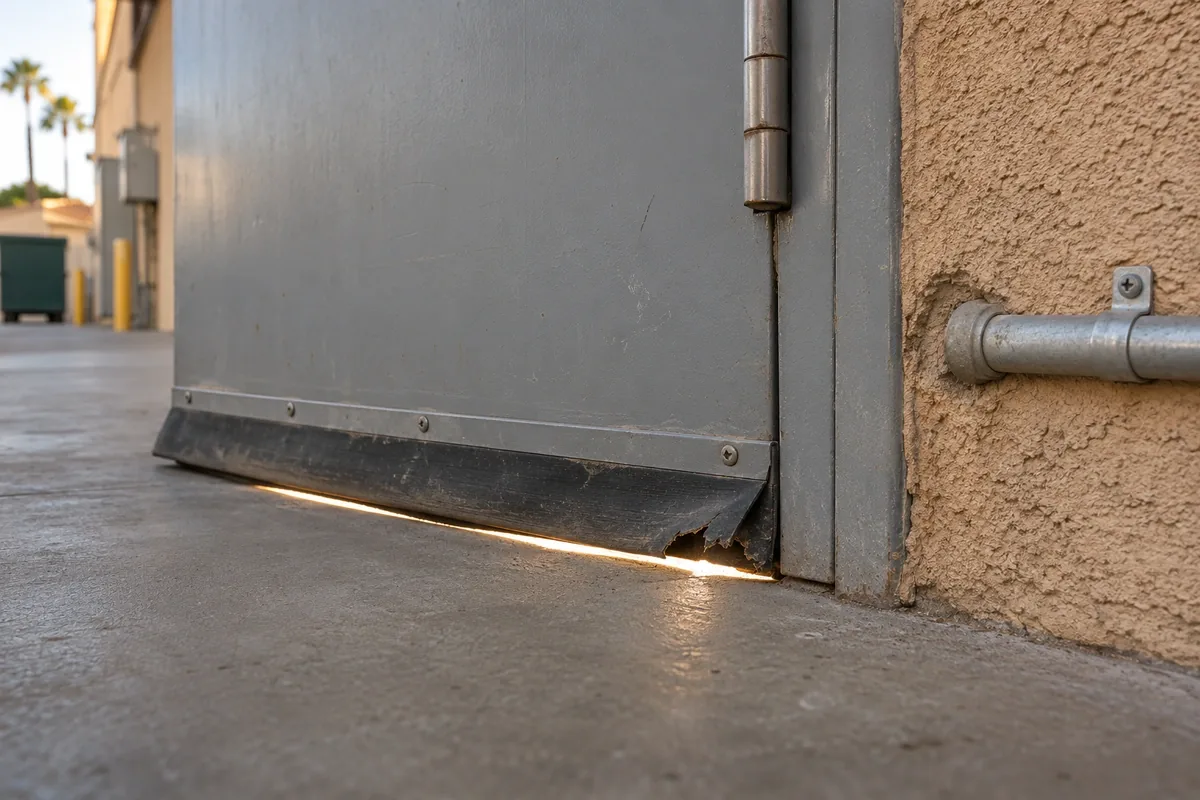
Daylight showing through a gap under a worn rubber door sweep on a commercial back door in a Southern California service corridor, a common rodent entry point
A worn sweep that lets daylight through is one of the most common ways rats and mice get into commercial buildings.

Why rodents move into commercial buildings in winter

Roof rats and house mice are active year-round in Southern California, but cooler nights and wet weather increase the pressure on buildings. Outdoor food and cover become less reliable, and a warm, dry structure with food waste, packaging, and quiet corners becomes more appealing. UC IPM notes that house mice frequently move into buildings in autumn as nighttime temperatures drop (UC IPM).

Commercial properties add extra draws that homes don’t have: dumpsters, loading areas, daily deliveries, and long quiet stretches after hours. A food source behind one building can support rodents that live under the next one.

Small gaps matterRats, especially young rats, can squeeze beneath a door with only a 1/2-inch gap, and house mice can get under a gap about 1/4 inch tall. UC IPM recommends sealing all holes larger than 1/4 inch to exclude both (UC IPM). A worn door sweep or an unsealed pipe penetration is usually all it takes.

Which rodents target Southern California businesses

Knowing which rodent you have tells you where to look for the way in.

Roof rat
Rattus rattus
An agile climber with a tail longer than its head and body. Roof rats prefer warm, coastal climates, nest above ground in trees and dense vegetation, and favor attics, wall voids, false ceilings, and cabinets indoors (UC IPM).

Enters from above · rooflines, vents, utility lines

Norway rat
Rattus norvegicus
A stocky burrower that digs along foundations, under trash piles, and in stored materials. Indoors it tends to stay on the ground floor, so docks, trash rooms, and storage areas are where it shows up.

Enters at ground level · foundations, doors, drains

House mouse
Mus musculus
Small, curious, and able to live entirely indoors. Mice nest in stored products, cardboard, and wall voids, and they are a common problem in food service, retail stockrooms, and offices with break rooms.

Fits through 1/4-inch gaps

For a deeper look at the species and how we handle them, see our guide to rodent control in Southern California.

Where rats and mice get into commercial buildings
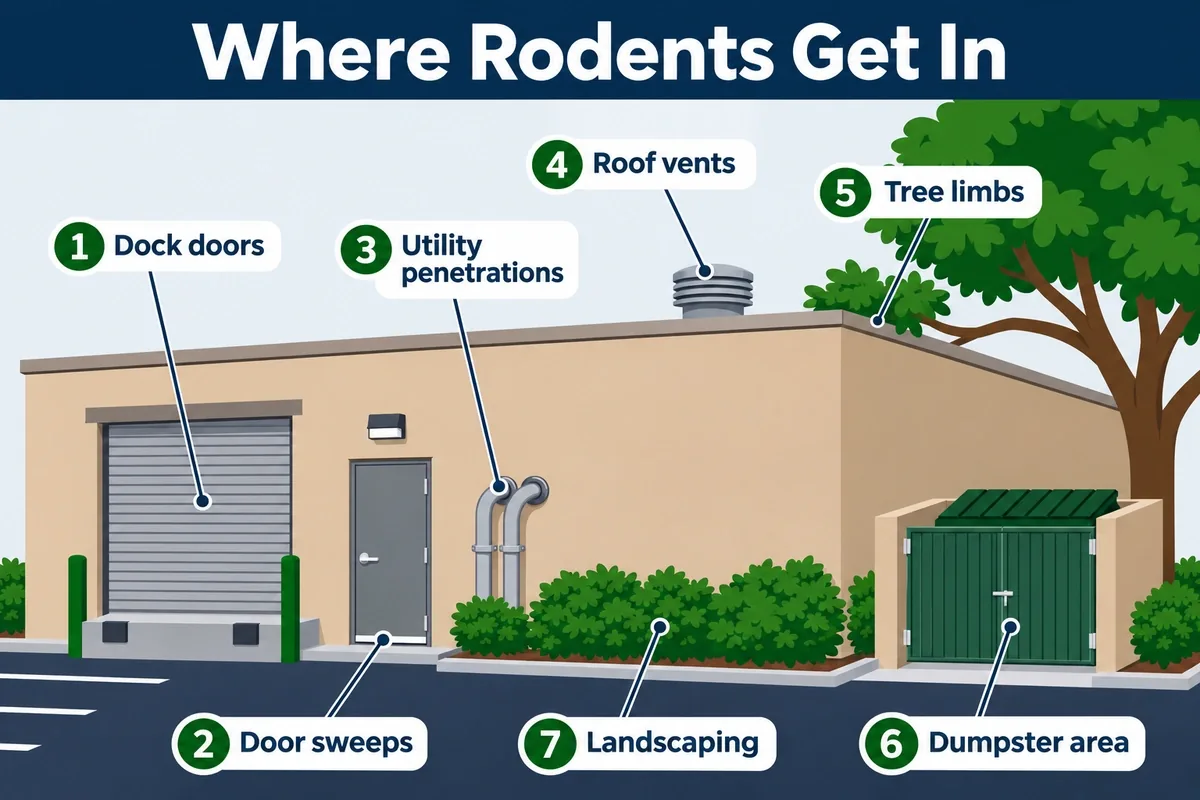
Infographic of a Southern California commercial building showing seven common rodent entry points: dock doors, door sweeps, utility penetrations, roof vents, tree limbs, the dumpster area, and landscaping against walls
Seven places to check first on any commercial property. Most entry points are at ground level, but roof rats also come in from above.
  • 1
    Doors and docks. Worn sweeps, gaps at door corners, and roll-up doors left open during loading.
  • 2
    Utility penetrations. Gaps around pipes, conduit, AC line sets, and cable entries. UC IPM recommends sealing them with materials rodents can’t chew, such as steel wool, wire screen, or sheet metal, since rats chew through plastic, foam, wood, and caulk.
  • 3
    Rooflines and vents. Tree limbs, parapets, and damaged vent screens give roof rats a path from above.
  • 4
    Dumpsters and trash rooms. Overfilled bins, open lids, and spills draw rodents close to the building.
  • 5
    Landscaping. Dense ground cover, palm skirts, and shrubs against walls provide cover and nesting.

The 15-minute rodent walk-through

You don’t need special equipment, just a flashlight, a phone camera, and a habit. Walk the same route each time so changes stand out.

  1. Start at the doors. Check sweeps, thresholds, and door frames. Look for daylight under closed doors.
  2. Check penetrations. Look at every place a pipe, wire, or duct enters the building.
  3. Walk the dumpster area. Lids closed, pad clean, and the container placed away from doors where the site allows.
  4. Look up. Trim branches away from the roofline and check vent screens and roof penetrations.
  5. Scan for evidence. Droppings, gnaw marks, grease rub marks along walls and beams, and tracks in dust.
  6. Photograph everything. Dated photos create a baseline you can compare after each storm.
AG Pest tip: Trapping reduces the rodents you can see. Exclusion stops the next group from arriving. A program that only does the first one will keep coming back.
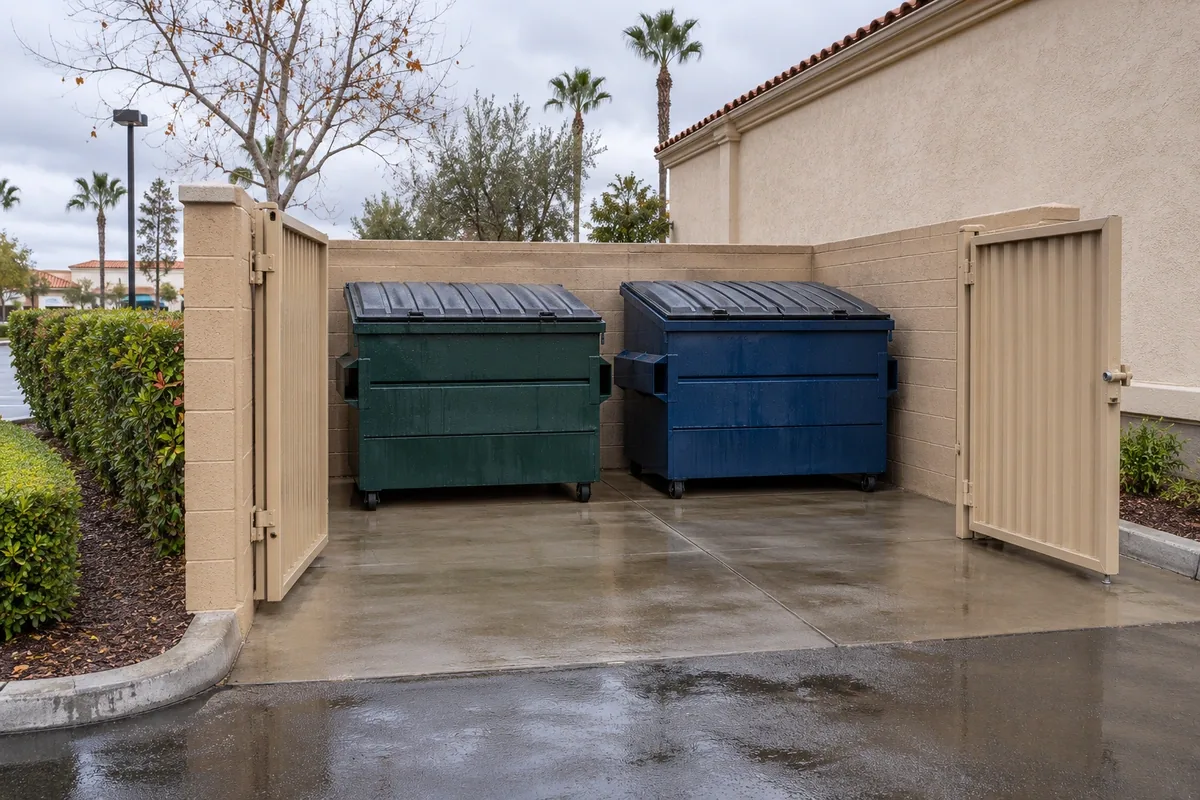
Closed dumpster enclosure with lids down and a clean, swept concrete pad behind a Southern California retail center
Closed lids and a clean pad take away the food source that draws rodents close to the building.

What to prioritize by property type

Restaurants
Back doors, grease, and trash
Kitchen back doors, grease bins, and dry storage come first. Our restaurant and commercial kitchen pest control guide covers inspection prep.
Warehouses
Dock doors and pallets
Dock seals, roll-up door bottoms, and an inspection gap between pallets and walls. Check incoming freight during holiday receiving.
Retail centers
Shared trash and stockrooms
One tenant’s dumpster or stockroom can affect the whole center, so coordinate walk-throughs across units.
Offices
Break rooms and ceilings
Mice in break rooms and roof rats above drop ceilings. Sealed food storage and ceiling checks go a long way.
HOAs
Common areas and notices
Shared trash enclosures, slopes, and palms need a building-wide plan. See our pest control guide for HOAs and property managers.

Trapping vs. exclusion: reactive vs. proactive rodent control

Reactive

Wait for a sighting or a complaint. Set traps and hope. No written record of conditions. Repeat the cycle every winter.

Proactive

Seasonal walk-through before the rain. Seal and screen entry points. Dated notes and photos every visit. Adjust the plan from trends.

UC IPM describes exclusion, or “building them out,” as the most successful and longest-lasting strategy for rat control around structures (UC IPM). Trapping still matters for rodents already inside, but it works best as part of a plan that closes the way in.

Rodent control records that hold up

Health inspectors, insurers, franchise auditors, and HOA boards all want the same thing: proof that someone is paying attention. The most useful records are simple:

  • Date-stamped service notes for every visit.
  • Photos of activity and of each fix.
  • A short list of recommendations, with an owner for each one.
  • A single person who answers the phone.

If a vendor can’t produce last quarter’s records quickly, that’s useful information.

County by county: what we see most

San Diego County
Roof rats along rooflines
Properties near canyons, palms, and mature landscaping often see roof rats working along rooflines. San Diego County rodent control
Orange County
Shared trash and loading areas
High-density properties with shared trash and loading areas need coordinated, building-wide plans. Orange County rodent control
Riverside County
Dock doors at distribution sites
Large distribution buildings with many dock doors make door sweeps and receiving habits the first priority. Riverside County rodent control

Want a second set of eyes on your property?

We’ll walk it with you, document what we find, and explain your options. No pressure.

Request a Commercial Inspection

Serving San Diego, Orange County, and Riverside County · Call (800) 696-8565

Frequently asked questions about commercial rodent prevention

Why do rodents become a bigger problem for businesses in winter?⌄
Cooler nights and wet weather make warm, dry buildings more attractive to roof rats and house mice. Commercial properties also offer food waste, packaging, deliveries, and quiet after-hours conditions that support feeding and nesting.

How small a gap can a mouse or rat get through?⌄
According to UC IPM, house mice can squeeze under gaps about 1/4 inch tall, and rats, especially young rats, can squeeze beneath a door with only a 1/2-inch gap. UC IPM recommends sealing all holes larger than 1/4 inch to exclude both.

What is the difference between trapping and exclusion?⌄
Trapping removes rodents that are already inside. Exclusion seals the entry points and removes the food and shelter that draw new rodents in. UC IPM calls exclusion the most successful and longest-lasting strategy, and the best commercial programs use both.

What records should a commercial pest control provider keep?⌄
Date-stamped service notes, photos of activity and corrections, clear recommendations with an owner for each one, and a single point of contact. These records make health inspections, insurance reviews, franchise audits, and HOA board meetings straightforward.

How often should a commercial property be inspected for rodents?⌄
It depends on the property type and risk. Restaurants and food facilities typically need more frequent service, while offices and warehouses may be serviced monthly or seasonally. A walk-through before the winter rains is a good time to reset the plan.

Do HOAs need a different approach than businesses?⌄
Associations have shared trash areas, common landscaping, and residents to communicate with, so building-wide planning and clear notices matter more. The inspection and documentation steps are the same.

Commercial rodent control across Southern California

Inspection, exclusion, and documented service for restaurants, warehouses, retail centers, offices, and HOAs.


Request Service

Questions? Call (800) 696-8565. We’re happy to walk you through your options.

AG
AG Pest Team
State Certified Pesticide Applicators · Southern California

This article was written and reviewed by the AG Pest Team serving San Diego, Orange County, and Riverside County. Since 1982, AG Pest has provided residential and commercial pest management across Southern California, with divisions specializing in general pests, rodents, termites, birds, and plant health care. Our technicians are State Certified Pesticide Applicators. Recommendations reflect integrated pest management (IPM) practices for Southern California.

State Certified Pesticide Applicators
Since 1982
Commercial and HOA Service
IPM Approach


Leave a Reply

Your email address will not be published. Required fields are marked *

More From the blog

Call Now Button